mountain area project management
On our ski areas, every development project is designed with the environment in mind. We strive to modernise our infrastructures while protecting the environment, preserving biodiversity, and supporting the local economy.
By combining responsible practices with sustainable technologies, we endeavour to reduce our impact on the soil, plants, and wildlife.
Before any project gets started, we carry out thorough environmental impact studies to ensure we comply with regulations and safeguard natural habitats. These studies consider all aspects of the project—social, economic, environmental, and visual—so that every decision balances progress with nature. No project can go through without confirming these essential criteria.
facts & figures
Going Further for the Environment
Each project is carefully studied and planned to minimise its environmental impact:
• Protecting sensitive habitats: limiting access and preserving areas with fragile or protected plant species.
• Preserving drinking water sources: all project works avoid water catchment areas to ensure a safe supply.
Protecting wildlife: marking and making cables visible for birds, and scheduling interventions according to nesting and breeding cycles.
The new installations have been designed to reduce their carbon footprint, optimise energy use, and extend their lifespan. They incorporate technical and architectural solutions aimed at minimising environmental impact:
• Greater energy efficiency: the new ski lifts use half the electricity per passenger compared with older models.
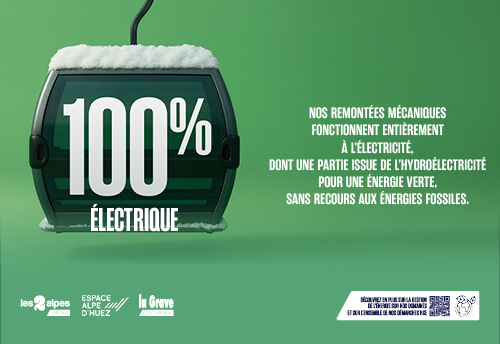
• 100% electric operation of all ski lifts partially sourced from hydro-electricity.
• 93% recyclable cabins: the remaining 7% can be recovered for energy when the cabins are replaced at the end of their 30–40 year lifespan.
• Responsible dismantling: old terminals and pylons are removed and sent through certified recycling or recovery channels.
• Landscape integration: the design of the new structures is intended to blend in with the mountain environment and reduce visual impact.
• Reduced visual pollution thanks to the removal of pylons from old installations.
Rigorous management of plant life is ensured by our partner companies.
The “étrépage” method is preferred: only the top layer of soil (grass, roots, humus) is removed, so it can be replaced afterwards to preserve the original vegetation. Topsoil stripping—the controlled removal of the fertile soil layer—is also carried out on all disturbed surfaces to maintain as much of the initial plant cover as possible.
After each project, our partner companies commit to implementing revegetation measures on affected areas, including land restoration and systematic re-seeding.
Local seeds and compost are used to preserve the natural plant life.
These actions are part of a long-term vision for mountain development, where every project aims to balance performance, safety, and respect for the environment.
Our teams and partners are committed to designing, building, and maintaining installations with a focus on efficiency, reuse, and the preservation of natural resources.
SATA GROUP–AEON manages the mountain areas through public service delegation contracts drawn up by the local municipalities. This means that all our actions are defined in collaboration with them and approved in advance, in consultation with all local stakeholders.
We strictly comply with all applicable regulations, particularly regarding the environment. Our development projects are systematically subject to rigorous administrative procedures and thorough supervision, including impact studies, prefectural authorisations, regular inspections, and monitoring by independent organisations.